How to get into the best grammar school

denim

A friend’s daughter turned 11 years old this year. As such her class cohort has just been subjected to the highs and lows of the 11+/ secondary school application process. For many children this is a very stressful time, albeit nothing compared to the trauma it is for the parents! I am pretty sure from my friend’s discussions that more parents lost sleep than children. At least I hope this is the case as most parents should be protecting their children from the burden of expectation, as feeling a “failure” at 11 years of age can have lasting consequences. The feeling from the school playground banter which can sometimes approach hysteria, would appear to be that it is substantially harder to get your children into a decent secondary school these days than at any other time in history, however I am never sure if every generation feels this (just like every generation of teenagers feel like they invented sex) and justifies it with current concerns (baby boom, “tiger parented” immigrants taking all the places etc.), or if it is actually true. The word on the London street these days is that if you are sending your child to a state primary school, they have “No chance” of getting into a selective grammar or independent school, unless they are receiving private tuition from at least the beginning of year 4. I have even heard some say that they need tuition from reception, and others say that you need to have their name down with the best tutors at year 1, as they all have mile long waiting lists. If you cannot afford private tuition, then they should be going to Kumon (after school maths club) at least; and the proliferation of Kumon classes across London attest to the power of this notion. If you are sending your children to a prep school, then even they may require private tuition from at least year 4 depending on how your child is doing or the quality of the prep school. If your child is not academically excellent, you could try and sneak them into an academic secondary school by way of a music or drama scholarship, in which case, investment into private music/ drama lessons would have been a requirement from well ahead of year 4, as to audition for a music scholarship at a prestigious school requires a distinction at grade 5 (grade 3 for less prestigious schools). All in all, one wonders about the truth of these rumours or if this is one big ruse to boost the nation’s economy and employment level by increasing consumer spending on “must have” educational add-ons. More worryingly, if this is the truth, then where does it leave children from less well-off families who are unable to afford extra tuition and music lessons?

My eldest child is in year 1, so I am currently in a position to be skeptical about the hysteria. By year 4, Big Sis may well be signed up to the best and most expensive tutor that money can buy to secure her place at “the best selective secondary school in the world ever that is her only salvation from failure, alcoholism, teenage pregnancy and delinquency”. However, from my current armchair standpoint I can only look on with bemusement. I am in the rare position for a Londoner of living in the same area where I spent the majority of my childhood, and having the possibility of my daughter sitting for entrance exams at the same school that I went to: “the best grammar school in London”. Her education and circumstances up to that point will have been somewhat different given my economic circumstances are somewhat better than that of my parents. That said, here is a commentary on how getting into the best grammar school was done in the late 80s.

My sisters and I attended a local state primary school in Wales. My mother, having been a secondary school science teacher in Taiwan, taught us maths after school every day. Since she could not speak English, she did not teach us English but attempted to teach us Chinese. Both my parents encouraged us to read in English and took us to the library to borrow books every Saturday. They also encouraged us to write stories and poems in English. When I was 8 years old, my parents moved to London where both my mother and father had found employment. Since my mother now started working full-time, we had no further additional educational input outside of school, albeit constant encouragement, and expectation of hard work and achievement. My eldest sister was at that important secondary transition stage. Contrary to the at-length planning of most parents these days regarding secondary transfer, my parents, uninitiated in “the system” took a “pitch up and see” attitude. My sister was enrolled directly into the local comprehensive as my parents could not afford private school and she had missed all the entrance exams and procedures for the grammar school. My second sister and I were to go to the local primary which was, and still to this day remains, at the bottom end of the primary school league tables. My eldest sister had many a happy lesson making wooden pencil cases and large clay sculptures of birds of prey, whilst effortlessly coming top in every academic subject. My other older sister and I spent many lessons re-learning how to read and write English with the largely “first language not English” class.

Contrary to the current parental angst over school decisions, my parents took the oft-forgotten-in-current-times view that if it all went a bit Pete Tong, then we could change schools. Within the year, both my sisters had aced entrance exams to the grammar school, one at common entrance, and the other for year 8 entry as a position had opened. I was transferred out of the state primary in our area, to a state primary in the further, but much wealthier suburb next door. How? My parents just applied. Children leave good schools all the time for all sorts of reasons, and if you play the waiting game, chances are you’ll get a place without the furor and hassle of making out that you live on the school’s doorstep at common entrance.

In contrast to my previous school experiences, primary school in leafy suburbia was a delight. Whilst at previous schools my work stood out, in this wealthy neighbourhood intelligent children were in ample supply, such that academic equals and superiors were available. Of the 30 children in my class in this primary school, I know that one other joined me at Cambridge. Another went to Yale and another two went on to study medicine at Oxford and at Bristol, and I am sure there are other successes that I have not heard of. It was my parent’s intention that I should follow in the foot-steps of my sisters into grammar school. Their naivety of the education system meant that they saw this as a foregone conclusion. No tuition was brought in, no music lessons arranged, no past papers ordered up. I remember being called out of class one day by the school’s head of secondary transfer shaking a yellow form at me saying “Your parents have put down a highly selective school as the only option on your secondary transfer form! What if you don’t get in? They must put down alternative options!” To which my genuine response was “But they’ve bought my school uniform already.” I had no idea that entrance heavily depended on my performance, it was just a FACT that this was the school where I was going and I just had to go and sit an exam and attend an interview to formalise the process. Thinking back, this is probably not the best strategy for parents to adopt, as it would have hit me hard if I had not followed my sisters into that school, but my parents were blissfully ignorant of the fierce competition as they were both working flat-out full time and barely spoke to any other parents.

I did nearly blow my chances of going to the grammar school “for Young Ladies” as it was then suffixed. In those days, following the Maths and English paper, you were subjected to an interview with the headmistress. The headmistress was exactly the kind of headmistress I would imagine for a school purporting to educate “Young Ladies”. An upper class lady with portly stature, portent demeanour and penchant for port; all blue rinse and pearls. I had to describe a painting by Braque that was presented to me on a postcard. I had to read aloud a passage of written text about rainfall. It contained the word “percolate”.  Here the headmistress requested a definition and I was at a loss. Trying to garner as much information as I could from the surrounding text, I offered a clearly wrong definition. No matter, the headmistress took it upon herself to educate me on the meaning of the word “percolate”. “You know, when you make coffee, you must let the water filter though the spaces between the coffee grounds to get the flavour. You have made coffee before haven’t you?” “Yes” I said. “I put a spoon of the granules into the cup, add hot water and stir. Is that what percolate means?”

Thankfully, being of the Nescafe-drinking classes may have excused my ignorance of the definition of percolate, and I was in. But that was the thing in those days. Raw ability got you through – not primed responses and taught vocabulary.

I am rather saddened to hear that my old grammar school has done away with the interview and rely on an IQ style test to screen candidates prior to entrance exam. On the standard IQ test, there is a 6 point test-retest advantage (this means that purely by having done the test before, the average person can improve their score by almost half a standard deviation). For clinical purposes if you want to get an accurate picture of a child’s IQ you should not test a child more than once a year. If however, you want to inflate your child’s IQ for a one off entrance exam, repeated exposure to IQ type tests can really do it, and schools will not be getting an accurate measure of “intelligence”. I can only imagine that doing away with interviews is a pity as however subjective, I still think there is something to be said for the spark in an eye and a quick-witted response.

In addition, from my current standpoint, although I value hard work and wish to pass this ethos on to my children, and although I know that hard work can greatly increase a child’s ability and potential, there comes a point where you as a parent have to recognise the innate (genetic) ability of your children, and pushing beyond ability can definitely have negative consequences. We would all like to believe that our child is the brightest bulb in the pack, but all except one of us would be wrong in this assumption. We might all like to believe that if our child “just did this/ or was given this opportunity/ or was helped more by their teacher” that they would become the brightest bulb in the pack, but again, the majority of us would be wrong in this assumption. For some reason, no one seems to want to admit the obvious, that some people are just cleverer than others – no ifs-ands-or-buts about it. Around the school gates, whenever a child’s exceptional reading or maths ability is discussed, someone will inevitably mutter “Yes, but you know what that parent is making the kid do at home…”, whilst my response is always – “great, it really helps everyone to have bright kids in the class”.

My gestalt realisation that ability is unevenly distributed happened at Cambridge University. I looked around me and thought “Not in a million years and working 24/7 will I ever be as smart as some of these people”. Accepting yourself and not feeling a loser about it is really satisfying, and I think we need to have the same reality check sometimes with our kids. Although aspiration and pushing to achieve potential is a positive, not all children have the same academic potential and ultimately we need to accept, appreciate and love them – in the words of Brigitte Jones’s Darcy “just the way they are”. My current view is therefore that if my children do not get into the most prestigious academic school then they probably would not have got on there. I would much prefer my children to perform in the top half of a less academic school, where they can feel “clever” and become confident in their academic abilities than flounder in the bottom half of an academic school. I saw many people at my school and university suffer crises of confidence (despite being exceptionally bright), due to being in the bottom half of a highly academic environment. Some of the negative effects lasted well into adulthood, and may well be life-long. In my view confidence, security, self-assurance and happiness are the solid foundation that childhood needs to build; academic excellence is definitely welcome, but never at the expense of the former.

I am desperately hoping that the rumour mill is hype and that old fashioned clever kids will still end up where they deserve to go and that good education does not become the preserve of the wealthy, but also that I will be strong enough in my current principles to follow through should my children not be “old fashioned clever kids”.

How smoke exposure in pregnancy can cause aggressive kids


boots

Wellies in summer are about as useful as aggression in Barnes


This is part 3 of the “How to improve the success of your kids before they are even born” blog series. See Part 1 and Part 2.

If folic acid is the Austin Powers of womb environment, then Dr Evil has got to be cigarette smoke. O.K., O.K., there are plenty of other bad guys obviously – thalidomide, heroin, alcohol. The reason I am casting cigarette smoke as the bad guy here is that whilst you have total control about exposure to the others, passive smoking is harder to control. The US Department of Health and Human Services (2006) estimated that more than 126 million non-smoking adults continue to be exposed to second-hand smoke in the US. Some of these millions are likely to be pregnant. Thank goodness for the U.K. law banning smoking in bars and restaurants. This was great for winter time, but having had both pregnancies through spring and summer, it was a real pain to anticipate a delightful al-fresco meal in the fresh air, only to find, given the laws prohibiting smokers from dining inside that all the outdoor tables at pubs and restaurants were over-run with smokers. Worse still, I found that friends would continue to light up in front of me in social situations when I was pregnant. Most of the time, I would alert them to smoking and pregnancy but this usually meant they moved a few paces away and tried to blow smoke in another direction with varying degrees of success. I’m not a smoking killjoy. I enjoyed cigarettes in my youth, and drinking in other people’s smoke used to bring back good memories, but when I became pregnant this changed and my mind would shout “TOXIN, TOXIN” if ever smoke touched my nasal hairs. Sometimes, not to cause a scene I just grinned and bore it, but images of damaged children would always run through my mind.

Most everyone knows that you shouldn’t smoke in pregnancy, but I’ll bet you didn’t know why? Studies have shown that there are over 4,000 chemicals in cigarette smoke and more than 40 of these are known to be linked with cancer (Thielen et al., 2008; US Department of Health and Human Services, 2010). Many of these chemicals, including nicotine, are able to cross the placenta into the foetus’s blood stream where, due to differing mother and baby physiology, concentrations can build up to higher levels in the foetus than in the mother (Lambers & Clark, 1996). Every time you have one, that’s two fags for the baby. There is evidence that links exposure to smoking in the womb to an increased risk of spontaneous abortion, pre-term delivery, and the baby going on to develop asthma, allergies, breathing problems and even cancer in later adult life. If you are a pregnancy smoker, you know all this and are as immune to this as being presented with a photo of a messed up smoker’s lung in the doctor’s surgery when they suggested you quit. What may influence you and what were my main concerns, were with the lesser known associations of smoking: with higher levels of aggression, conduct problems, attention problems, impulsivity, memory, speech and language and intelligence (Knopic 2012). It shouldn’t really sway you more, but put it this way, if your child develops cancer in adult life, it’s a long way off and is largely their problem to deal with. If your child is prone to aggression, that’s going to be your problem in a matter of months to years! If you did already know that, then I bet you didn’t know how cigarette smoke does this?

If you do then you are well ahead of the scientists! Scientists are still hard at work on this, but their current hypotheses surround the fascinating ideas around foetal programming and epigenetics. The theory of foetal programming is attributed to David Barker. David studied a group of mothers who were pregnant during the Dutch famine of 1944-1945 and followed up on the consequences of the children who were in utero during the famine. These mothers suffered malnutrition and stress, the children exposed to maternal starvation and stress were found to have lower birth-weight which is of no surprise. However, despite the end of the famine and a return to plentiful food supply, these children went on to have worse adult outcomes than children conceived just after the famine ended. These included cognitive deficits and higher likelihood of type 2 diabetes, heart problems and obesity. Barker’s theory is that there is a mechanism for Darwinian adaptation to environment occurring right there in our swollen abdomens that has probably been responsible for the success of our species. He postulated in the 1980s and 1990s that the developing foetus could take on information from the mother’s womb environment and use this to “forecast” the state of the environment into which it would be born. It is then able to prepare itself by adapting to be able to best survive the predicted environment (generate a predictive adaptive response); in much the same way that we might reach for the umbrella, coat and wellies on hearing a weather forecast for rain. Thus, if the developing foetus finds itself in an environment in which nutrients are scarce (such as the Dutch Famine) it thinks to itself “Bugger, I’m in for it when I get out, if my mother can’t find enough food to eat, there’ll be no damn food for me!” It therefore adapts (programmes) itself to be small and thrifty (conserve and use minimal resources) in order to be able to best survive the harsh environment it will face on birth.

Through this mechanism our ancestors lived to survive droughts and famines long enough to reproduce and eventually generate us. The foetuses that did not adapt themselves in this way would have died in infancy and childhood not being resourceful enough in their physiology to withstand periods of deprivation. The problem occurs if the forecast is wrong as adaptations made at these early stages of development are generally permanent. In the Dutch famine group, conditions improved after 1945 and food became plentiful again. The small and thrifty babies turned into children and adults that continued to store everything they ate and basically became more obese and prone to obesity related diseases, compared to children from similar backgrounds born just a year or so later. This is the fool in his heavy overcoat, wellies and umbrella at the beach in 30 degree heat cursing Michael Fish’s dodgy weather report.

How the foetus is able to use womb environment information to affect changes in its development is thought to be by epigenetic effects. In essence, epigenetics is the study of which sections of DNA gets expressed. In my analogy of DNA as a large manual for human construction, epigenetics is the study of the post-it notes put into the manual to instruct the builder which instructions to follow and which to ignore. Scientists have discovered several ways in which these post-it notes can be inserted, one of which is by a process called “DNA methylation”. Smoking has been shown to affect this process and others implicated in epigenetics which activate changes in the placenta (which can then affect the development of the foetus) and foetal development directly (Knopic, 2012). Epigenetic changes can also be inherited and can continue to influence at least 2 generations of descendants (at least in insects-Matthews & Philips 2010), thus what you do in pregnancy now may not only affect your children, but also your grandchildren!

A foetus exposed to high levels of toxins (like cigarette smoke) might prepare itself by bolstering its immune defences. On being born to a toxin free environment, the hypersensitive immune system gives rise to asthma and allergic reactions, which are essentially immune responses to normal everyday surroundings. It is harder to understand the adaptive nature of the psychological associations of prenatal exposure to cigarette smoking (aggression, impulsivity), but it makes sense that if toxins are part of what can be described as a “hostile” environment, that the newborn baby and subsequent child should be prepared to look out for danger and fight its way in the world. Aggression, hypervigilence and risk-taking behaviour would be beneficial traits to aid survival of a toddler in an Armageddon situation, but probably not so beneficial in a 3-bed semi in Barnes.

I went to a Justin Timberlake concert when I was pregnant with Big Sis and she came out ready to dance! Does that count?

References

US Department of Health and Human Services. (2006). The health consequences of involuntary exposure to tobacco smoke: A report of the surgeon general. Atlanta, GA: Centers for Disease Control and Prevention.

Thielen, A., Klus, H., & Muller, L. (2008). Tobacco smoke: unraveling a controversial subject. Experimental and Toxicologic Pathology, 60, 141–156.

US Department of Health and Human Services. (2010). A report of the surgeon general: How tobacco smoke causes disease: What it means to you. Atlanta, GA: Centers for Disease Control and Prevention.

Lambers, D. S., & Clark, K. E. (1996). The maternal and fetal physiologic effects of nicotine. Seminars in Perinatology, 20, 115–126.

Knopic, V.S., Maccani, M.A., Francazio, S. & McGeary, J.E. (2012). The epigenetics of maternal cigarette smoking during pregnancy and effects on child development. Development and Psychopathology 24 (2012), 1377–1390.

Matthews, S.G., & Phillips, D.I. (2010). Minireview: Transgenerational inheritance of the stress response: A new frontier in stress research. Endocrinology, 151, 7–13.


Pass on a passion

swimming

Victoria Pendleton’s father loved cycling. Luckily for GB cycling, he passed on the cycling bug.

To me part of the joy of parenting is being in a position to pass on a passion. Seeing a little person’s face light up with enjoyment in doing something that you enjoy, and being able to do something you enjoy with the best little people in the world. Nothing beats it.

It therefore seems really strange to me to find the plethora of children’s clubs and classes where little ones can learn everything from swimming and yoga, to decoupage and cookery from strangers, alongside similar classes for adults with a crèche attached so parents can pursue their passions unfettered by their children. This uncoupling of parent and child “leisure time” is great for industry, twice the money, but seems to me to be doing us a disservice. Feeding into exhausted parents’ need for “me time”, and the parental competition for “most accomplished child”, it has generated a cult of “professional class attendance” denying parents the simple pleasure of passing on a passion.

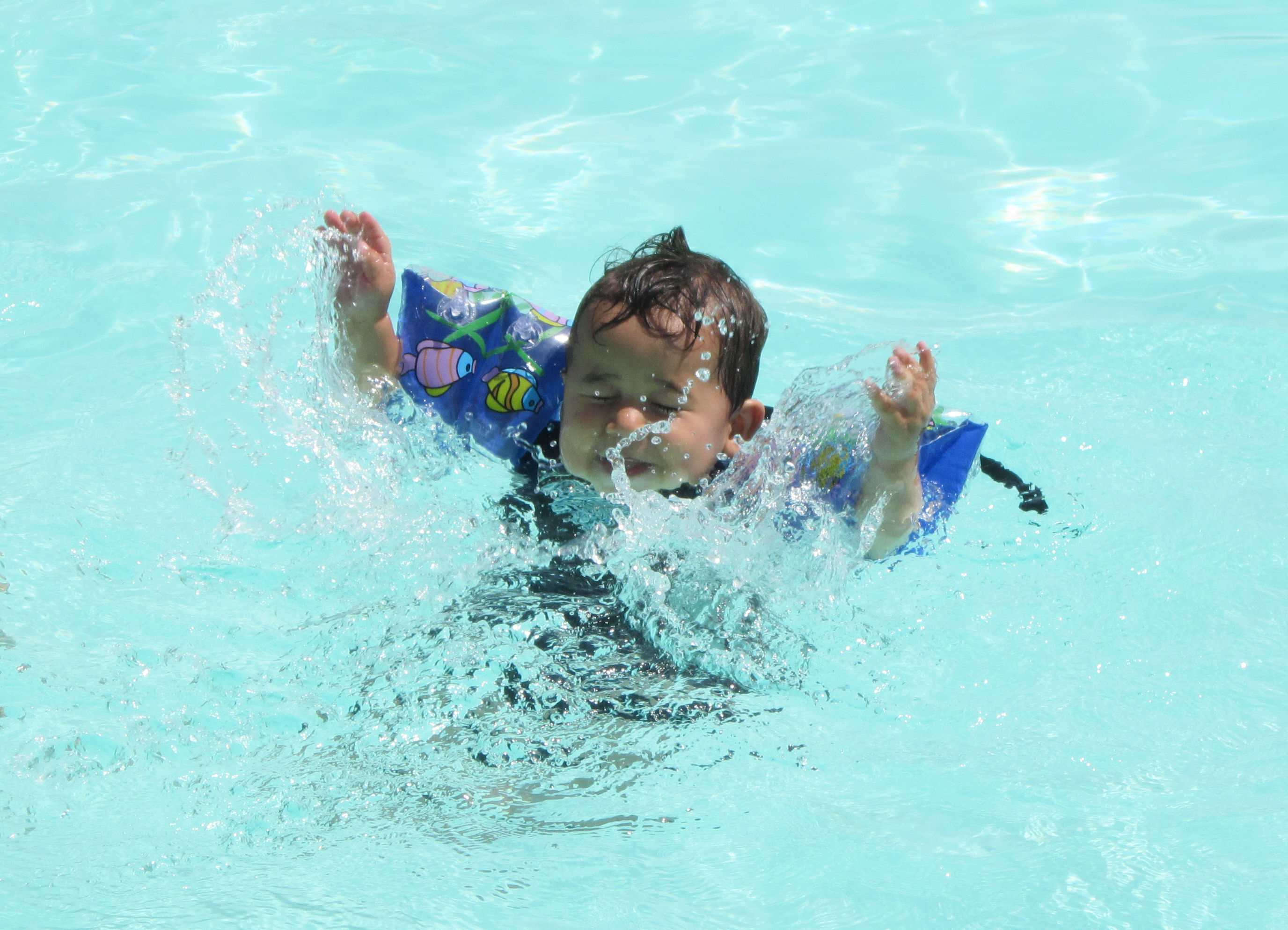
My husband and I taught both our children to swim. I am not the most accomplished swimmer, but I am able to stay alive in the deep end of the swimming pool. Swimming is a potentially life-saving skill and the quicker a child learns to stay alive in water, the better in my book. For my husband, swimming is a passion. He dreams of holidays swimming with teenage children between Greek islands (I will be going in the boat, glass and magazine in hand). Thus we made a point of taking the children to play in water regularly since the age of 3 months. The tiger mother in me, wanted to progress from “play” to “swim”, and over a summer when Big Sis was 4 years old, I managed to teach her to swim 5, then 10 metres. It was a great feeling when she managed it, both for her and for me. She positively beamed and wanted to do it again, and again. I was right there next to her in the water (holding on to 2 year old Lil Bro with his arm bands on), shouting “I knew you could do it!” I took added pride as a private swimming instructor who was also using the pool to teach at the same time asked me who had taught my children to swim as they were both “so confident in the water”, and I was able to reply “Me”. Now that Big Sis is able to swim, she is enrolled in professional lessons in a club to learn and refine strokes, but the pleasure of watching her gain mastery over the water was all mine.

It was sad then when a friend who was an excellent swimmer asked me to recommend a swimming instructor for her toddler. I asked her why she didn’t teach her child herself, to which she responded, “I can’t; I’m not qualified”. I can see how you need professional qualifications to teach a group of children, or to teach children to swim strokes, but I was taught to swim by my dad, and my husband was taught by his parents as were the majority of people of my generation. So why shouldn’t modern-day parents feel qualified to teach their own children to swim? Probably because of the many advertised toddler swimming classes advocating professional guidance and undermining our confidence in our own ability to teach. It will be a really sad day when children are sent to professional classes to learn to cycle and bake cakes, as to me, teaching and doing these things with your young children is a rite of passage for parents. Or if you hate baking and cycling then snooker, oboe, tennis, skiing, poetry, jazz music – don’t keep your passions to yourself and send your children out to generic classes. Pass it on.

My own passion is for art. Having been forbidden to go to art school by my parents (which in their eyes meant a life time of poverty), I continue to have pleasure in painting, sculpting, making things and visiting art galleries. From a young age, the children have always come with us to art galleries in London and abroad. Art galleries are great places for children, as they usually feature wide open spaces. Our children wake up at 6 am, so getting to the Tate Modern at opening is no problem, and at that time on a weekend morning, when sane people are still tucked up in bed (or even just going to bed from the night before – ah those were the days), the gallery is quiet and the children can be let loose. Their attention span is short, so we are never able to take the thoughtful meander that we would have in our childless days. But becoming a Friend of a gallery is great, as you can literally pop in to see one picture and leave without feeling it was a complete waste of money, and in London, there are also so many free art galleries, that this is possible even for those on a budget. Most times, I will ask the children to choose their favourite painting, or I will point out mine and we will look at it in detail. At other times, I will bring paper and pens and they will sit and copy their favourite paintings. Other times, we will paint a picture together at home afterwards, “inspired” by our gallery visit. Many exhibits are child-friendly and I can recall Lil Bro aged 3 shouting “Moo” in delight at Damien Hirst’s cow, completely unperturbed by the fact that it had been cut in half, and Big Sis in hushed tones at Anish Kapoor’s exhibit involving a wax cannon saying “Mummy, someone has made a mess in here”. Of course, it’s not all roses and there are many times when I have had to drag sulky kids, carry sleeping kids, bribe whinging kids with gift-shop magnets, but when you later find that they can talk about “Mango’s sunflowers” or say that their favourite artist is “Kandinsky”, it can bring joy to the heart. Many galleries these days have great family days where you can work WITH your children on art projects, or at least ALONGSIDE, and they are usually FREE.

Free art activity

Free art activities in London at The Royal Academy of Art, Tate Britain and The Camden Art Centre.

I have great satisfaction in hearing my children say “I love art” and embark with confidence in creating something from their own imaginations, and I am dreaming of the painting holidays in Tuscany that we will be able to take together in the not so distant future, because of the time I have taken now to pass on my passion.

Pass it on.

Pass it on.

Doing art

Doing art and gallery visits. A broken leg doesn’t stop a gallery visit to the Van Gogh (“Mango”) Museum, and the floor of the Hermitage is as good a play space as any!

The Battle Hum of the Tigger Mum

tigger

Most Western parents who read Amy Chua’s “Battle Hymn of the Tiger Mother” book read in horror. For those who have not read the book, it recounts the strict disciplinarian parenting style and relentless focus on academic and musical achievement of a Chinese parent. For people brought up in the Far East, it’s different. On a visit to a friend in Hong Kong, I asked her if she had read the book. She looked at me hard to decipher whether I would judge her if she were honest, before replying; then we both laughed in agreement that for us “What she describes is just normal.”

I’m not saying it’s normal to timetable your children’s free time so that they are working all day and collapse exhausted at night, or to emotionally blackmail your children into 4 hours of piano a day, but the tiger parent ethos of involvement in your child’s education and emphasis on scholastic achievement is part and parcel of Chinese, and many other cultures. In reality, I don’t think that this is too far removed from Western values. There are also many Western parents who “expect” their children to achieve; the difference is that they “expect” their child’s school (particularly if it is fee paying) to deliver this expectation rather than to be personally involved. To this end, if Johnny does not get into “the best school/ university”, the teachers can expect a parental rant, whilst for the Chinese parent, either the child would have delivered the expectation (due to the parents’ support) or the parents will feel like complete failures and blame no one more than themselves. To the Chinese parent, the Western attitude of abdicating responsibility for education to schools is rather strange. To the Chinese parent, the school (however good) is only one arm of the education battery, rather than the entirety and personal responsibility is taken for education.

This usually involves extra work at home (to a varying degree from acceptable to bordering on abusive), educational outings (museums, libraries, art galleries, historical landmarks), educational conversation (ranging from fully answering any question the child asks (possibly involving graphs, Venn diagrams and how to construct a computer program to answer that exact question…), to grilling on times-tables and “What’s the capital city of…”) and mostly an extreme nosiness on the state of their child’s performance in relation to other children (whereupon, if there is a hint of not keeping up, efforts are redoubled). When test scores come back less than perfect, there is a focus on the mistakes made rather than correct answers, not necessarily because anything less than perfection is acceptable (although there is this too!) – but because the parent is trying to understand where the child requires additional help so that they can provide it. All this is quite frankly a lot of hard work, but a Chinese parent will feel somewhat a failure if they do not do this (to greater or lesser degree) as it’s practically in their blood.

Understanding where this parental drive comes from is important as it is purely a case of Darwinian adaptation to environment and survival of the fittest at its best. Historically in the East, as was the case in Jane Austen’s times, the future of your family and your predicament in old age was dependent on either securing a good job for your son or a marital match for your daughter. In the West where these were achieved by birth right or having refined manners, children were encouraged to look down on lower social classes or were indoctrinated to sit up straight, know their soup spoons from their dessert spoons and make gentile conversation lest Mr Darcy be in the vicinity. In more meritocratic societies where a peasant with a PhD could become better regarded than a banker’s son without, having academically accomplished children is an economic investment. Generations of positive selection for successful “tiger mothers” has led to a society where tiger-parenting is the norm. Interestingly enough though, now that the job market is becoming increasingly global, “Who your parents are, or which school you went to in the UK” is paling in significance to university degree obtained in the worldwide jobs competition, and as such I have witnessed more and more British tiger parents emerging. For example, in my children’s Mandarin class (which my children are sent to purely to be in touch with their cultural identity), half the children in the class are European, sent to learn mandarin at age <4 years to enable them to be “competitive” in the future jobs market. There are also parents living in tents overnight to be the first in the queue to obtain application forms for sought after academic schools and gymnastic classes. I think tiger parenting has definitely arrived in the UK.

My personal view is that achievement is important. Achievement, “developing to the fullest” and “achieving potential” is a ratified right in the UN Convention on the Rights of the Child (alongside the right to healthcare and education). Encouraging work ethic in children to obtain achievement is not a sin. To this end then, I fully put my hands up to being a tiger mother. Do I check my children’s homework? Do I stress the importance of getting all their spellings right? Do I make them do 10 minutes of a workbook each day on top of work set by the school? Do I supervise their reading every day? Do I coerce my daughter to practice piano for 10 minutes at least 4 times a week? Do I insist (with varying success) this continues in the holidays. Do I express disappointment if I do not think they have really tried? Do my children think that my favourite hobby is doing workbooks with them? Do I pack a “Make your own volcano kit” in our suitcase for a holiday to Sicily as I know we will be going up Mount Etna and I want to explain how it works to the kids? When I go to their school, do I scrutinize the work of other children in the class and compare it to that of my own kids? Yup.

However, I would also agree with Western values that scholastic achievement is not the be all and end all for success. It is interesting that in the UK the Chinese population outperform other ethnicities in school exam grades, yet they continue to under-perform in employment thereafter considering their academic qualifications. The Guardian 2011, reporting on findings of the Equality and Human Rights Commission Report stated “British Chinese youngsters are the highest performing ethnic group in England at GCSE”, and “British Chinese men and women were twice as likely to be in professional jobs as their white British counterparts. But average earnings remained around 11% lower throughout the population than for those classed as ‘white Christian’”. I would argue that this employment underperformance of the British Chinese is in large part due to the fact that their critical period of development (childhood) was too focused on academic attainment at the cost of interpersonal skills. Play-dates, parties, drama club, debating team, sports teams afford regular opportunities to practice social skill. What better way to learn the diplomacy and politics of the board room than years of practice in the locker room? Whilst largely attainment alone will get you into a top university, it is interpersonal skill and political savvy that will get you into the Western boardroom.

Further the cultural focus on respect for elders, authority and hierarchy indoctrinated in Chinese homes that facilitate academic achievement and lead to success in the workplace of the East, inhibit the free thinking, challenging of norms, stepping outside chain of command and assertive attitude required in the Western workplace. Transplanting elements required to succeed in one environment (the East) into another (the West) can only get you so far, and again, harking back to Darwinian theory, adaptation to new environment is required for success. Another approach to think about this adaptation to environment is in relation to Westerners hoping to crack it with the Asian premiere league now that China is touted to be the next super-power. Your received pronunciation won’t get you noticed, but it generally helps if you have a PhD from a top global University.

Further, although “success” is paramount to the tiger parent, this is measured purely in terms of academic/ career and financial success. What of “happiness”: my preferred measure of success? In psychiatry you have the rare position of seeing the psychological mess behind the veneer of many successful people, and you quickly realise that “happiness” is a much better yardstick for success. In my clinical practice I have asked many a tiger parent that has taken things to the extreme: “What’s the point of your child going to Oxbridge if they commit suicide there?” (it does happen). Of course, achievement and money contribute to “happiness”, which is why I continue to maintain these are important, but self-esteem, integrity and robust personality take precedent in my book. None of this “inferiority” coupled with “superiority” package that Amy Chua is now marketing (this by the way, sounds like the professional description of a personality disorder not the secret to success). What I advocate is pure and solid (and highly unmarketable): self-esteem, self-respect, respect for others, positivity and humour.

How can this be engendered?

To a large degree by parents.

Parents that spend time with you, and enjoy spending time with you. Parents that prioritise you and make you feel special. Parents that care enough about you to tell you when you are out of line. Parent’s that give you a reality check when you need it. Parents that listen to you when you speak, or speak for you when you can’t. Parents that make time for you even when they have no time. Parents that pick you up when you are down. Parent’s that are always there for you. Parents that cheer for you even when you are actually pretty rubbish. Parents that include you. Parents that know you and try to understand you. Above all, parents that make you live, laugh and enjoy life.

Alongside my workbooks and volcano making kits, I hope to practice this ethos too. To this end, I would like to be a Tigger mother. A tiger none-the-less, but one that is soft, cuddly, laughs, and is full of fun.

And probably quite a bit annoying.


References:

Mansell, W. (2011) Hidden Tigers: Why do Chinese children do so well at school? The Guardian, Monday 7 February 2011.

Amy Chua (2011), Battle Hymn of the Tiger Mother, Penguin Group; ISBN: 978-1-59420-284-1.


Zombies and Easter

20121005_152

Big Sis asked me what a zombie was the other day. Here is our conversation:

Big Sis: Mummy, what’s a zombie?

Me: It’s the undead. Like, the living dead.

Big Sis: Huh?

Me: It’s like, someone who is half dead.

Big Sis: You mean like [gesturing a line through her face and body] this side is dead and this side is alive? (they have clearly been learning about “halves” at school)

Me: No! [struggling, then remembering “Shaun of the Dead”] They are people that walk around like this [now giving my best “Shaun of the Dead” zombie impression with stiff arms outstretched moving up and down]

Big Sis: You mean a puppet!

Me: [Aargh! This is tough] No, no, no! It’s like some one who has died but then comes back to life.

Big Sis: Oh! You mean like Jesus Christ!

Totally not what I meant, but very funny.


HAPPY EASTER EVERYONE!

Photograph by Giorgia Bertazzi

Autism and Empathy

guinea pig

What is autism?

When I give people the formal definition of autism, I see their eyes glaze over as it is rather long winded and meaningless to those who know little about autism. So I’m not going to talk about autism diagnosis, which is somewhat complex, but one aspect of autism: empathy.

Many people equate “lack of empathy” with autism, so much so that whenever someone has been inconsiderate, others may joke that they were “being a bit autistic”. Say this around me and I get really annoyed as autism is more than lack of empathy and most inconsiderate people are not autistic. Autistic empathy problems are fairly specific. Hurting other people without remorse is generally considered as “lacking empathy”, although shrinks prefer to use the term “callous and unemotional” as it does not ascribe a cause to the behaviour. This is important as there can be many different causes to this type of behaviour.  I will give you 3 adapted real life examples of callous behaviour involving the death of an animal to see whether you can identify the one most likely to be a case of autism.

(a)   A 5 year old boy was playing with his pet hamster. The hamster bit him as he was a bit rough. The boy got his baseball bat out and bludgeoned the hamster to death. In explanation of what had happened, he showed no remorse and said “It bit me on purpose, so it deserved to die”.

(b)  A 10 year old boy was playing golf. He was very good at golf. A squirrel appeared in his line of sight, and he had the question as to whether his driving accuracy was good enough to hit the squirrel. He hit the squirrel with the golf ball striking the squirrel hard and killing it. In explanation of what happened, he showed no remorse saying “My aim is very good”.

(c)    Two 8 year old boys were pulling at a cat’s tail to hear it hiss which they found funny. They tied string to its tail and used that to pull it around. Then they thought it would be funny to set the string alight, which then set the cat alight. In explanation of what happened, they showed no remorse saying “We don’t know what happened to the cat; it had nothing to do with us”.

In Big Sis’s Oxford School Dictionary (apologies, this is sadly the only dictionary our household possesses), empathy is described as “Noun. The ability to understand and share in someone else’s feelings”.  In order to empathise, you require the ability to do the following:

1)      Be aware that other beings (animals or humans) have independent thought, action and feeling; this is sometimes called having a ‘theory of mind’.

2)      Be able to experience and recognize your own emotions and feelings and the situations in which different emotions arise.

3)      Be able to imagine that others may have the same feelings, emotions and thoughts that you experience if they were in similar situations.

Autistic “lack of empathy” relates to inability or difficulty with the fundamental step, step 1, which impacts ability to completely master steps 2 and 3. This “step 1” ability is something that you either have, or don’t have. It relates to abnormal brain wiring which goes awry in pregnancy and early infancy. None of us were ever sat down and taught “this is a table: it does not think, act or feel; this is a human, it is able to think, act and feel”, we just realise it ourselves one day, usually in infancy. To an autistic child, something this fundamental is not obvious. A typical complaint from parents of autistic children, and what I imagine would be the most painful as a parent; is that an autistic child may see parents as no different from anyone else, or indeed, any other object. An autistic child may show interest in a parent as a “biscuit dispenser” or “toy-buyer”, but are unlikely ever to have an intimate and confiding relationship with anyone including their parent, due to their inability to recognise other people as thinking, sentient beings. It is hard to comprehend or to believe, but if you are not naturally aware that other people have independent thought or feeling, then the death of a parent would affect you as much as the loss of a toy (provided someone else stepped in to dispense biscuits and buy toys). Classically, without step 1, steps 2 and 3 are impaired. Autistic children find difficulty in describing emotion in themselves as well as others. Some autistic children with good intellect are able to behave empathically. They are able to actively learn that others are thinking sentient beings, and are able to learn what someone would feel and think in a given situation. They learn it in much the same way that we might learn the highway code. It does not come naturally, but we can learn to behave in the way that is required of us. Just as with the highway code learning, actively learnt behaviour can slip in times of tiredness or stress, and is useless in new situations where the rules are unknown.

“Lack of empathy” frequently occurs in children without autism. The work of the clinicians in an autism assessment is to differentiate these children from autistic children.

Children with ADHD, who have a different brain wiring problem have a tendency to impulsivity. They can behave as if they lack empathy as they typically do things without thinking. If someone falls over, it can look very funny. All of us like to laugh when we see people falling over, which is why slapstick comedy is so successful. In real life, most of us would be able to inhibit our impulse to laugh if the person was actually hurt and crying in pain. The ADHD child, cannot inhibit impulses, and therefore will laugh, appearing to “lack empathy”. However, if you question the child afterwards they are able to interpret the situation empathically and realise that they should not have laughed, although they might say “but I couldn’t help it.” Of course some children with ADHD will also have autism spectrum disorder, as one brain wiring problem increases the risk of another.

Other children without brain wiring (neurodevelopmental) problems can develop difficulties with steps 2 and 3. For step 2, I will give two simple examples, but there are likely many permutations for the development of what shrinks call “callous and unemotional” symptoms in the absence of autism. Firstly, Children who are emotionally neglected and not stimulated to interact with others and experience emotion can have difficulty in experiencing and recognising emotions in themselves and others. The classic example of this is from Romanian orphanages. After the fall of the Communist government in Romania in 1989, aid workers found thousands of abandoned children being housed in orphanages in terrible conditions where abuse and neglect were rife.  Babies were literally left alone in cots day in and day out with minimal human contact. When discovered, many of these children appeared to be autistic, as they had difficulties with social interaction, communication and empathy. However, the majority of these children, when adopted out to loving families, gradually acquired the ability to empathise and socially interact normally. Their early childhood experiences of neglect had impaired their ability to experience emotion amongst other things, and therefore they had difficulty in understanding emotion in themselves and others. Love, not rote learning of rules was able to restore their empathy as the majority did not have brain wiring problems.

Secondly, young children who suffer emotional abuse (which can occur alone or with physical and sexual abuse) or are constantly witness to violence and trauma, may have had no biological difficulty in experiencing emotions, but as their emotions are too hurtful due to the extremely stressful environment, they may employ a defence mechanism of “blocking out” or “numbing”/ “desensitisation” of emotions in order to survive. Channelling “I am a block of wood” is sometimes your only defence in a situation where you are entirely powerless. These children find allowing themselves to experience emotion difficult or impossible, which limits their ability to understand emotion in others, even long after the abuse/ trauma has ended.

These two groups of children may have “attachment disorders”; some may grow up to develop “personality disorders”. Emotional availability of parents and care givers and exposure to violence lie on a continuum, and it is likely that even within the general population, there is variation in how in tune people are with their own emotions and the emotions of others even if they have not been through abuse and trauma.

There are children who have no difficulty with step 1 and 2, but have problems with step 3. They understand that people have emotions and they experience their own emotions. However, their own emotions are so over-encompassing, often due to insecurity; that they are unable to think about or care about the emotions and feelings of others. These children may have suffered abuse or neglect as children and pushing heavily for their own needs and wants has been the only way they have been able to survive. If these children are asked about emotions, they are able to describe them well. They are able to demonstrate theory of mind in non-emotive tasks and may even, in a hypothetical scenario that does not involve them, have no difficulty in seeing both points of view. However, when the scenario is switched to involve them, their thinking becomes self-focused and there is no room to think about other people’s feelings. Their own feelings are always prioritised over that of others. These children may be thought of as “narcissistic” and may grow up to have personality difficulties.

Finally, there are children who have no problem with empathy but choose to behave in a hurtful way to other people for their own reasons; they gain pleasure from being in power and deliberately causing pain, to gain membership to a culture or subculture, to extort money, to gain respect or retribution to name a few.

Hopefully, by now, you may have a better chance of determining which of our “animal killers” is the most likely to have an autistic spectrum disorder. Scroll down, to see if you are right.


Case (a) by ascribing intent to the hamster is in possession of basic theory of mind (a more clearly autistic response in this situation would have been to say “The hamster was hurting me so I stopped it from hurting me”); in this case additional examples of behaviour would need to be examined to argue a case one way or another. Case (b) has autism. There is clearly no theory of mind going on here, the squirrel was a mere target for target practice and may as well have been an inanimate object. Case (c) is definitely not autism as cooperating to torture a cat requires social skill between the two boys, unless there is a clear “leader” and “follower”. By attempting to deceive people by denying knowledge of what happened implies quite a sophisticated theory of mind. They would need to realise that you did not know what really happened, and that if they denied knowledge, they may be able to convince you that they were not involved.

Autism has several other criteria (the formal definition of autism being of “a triad of difficulties in social interaction, communication and restricted and repetitive interests”),  so you would never make a diagnosis based on something as simplistic as the above.  It is however useful to illustrate the importance of detailed information in assessment of every single feature of autism as scenarios which present behaviourally in a very similar way (e.g. killing of an animal) may have very different causes. A typical autism assessment involves information gathered from multiple sources and in depth interview and observation by a multi-disciplinary team.


In praise of praise

thumbs up

Parents differ on their view of praising children. Some parents praise their children for breathing; “Wow son, you drew breath; and you’ve done it again. It’s amazing how you can keep doing that.” whilst for others, drawing a compliment requires Herculean feats. Proponents of the former are generally enthusiastic Americans (it’s a stereotype I know, but I’ve often found North Americans to be generally more positive and energetic than folk on our side of the pond). Proponents of the latter generally take the view that kids are bright and if you keep praising them for everything, then the praise will be de facto meaningless. They think praise should generally be used sparingly and reserved for impeccable achievement.

Where do child psychiatrists stand on the issue of praise? Well, definitely in the camp of the enthusiastic Americans. Praise is good and should be shared not spared! If, as a kid you ever received genuine praise for a job well done from your parents, then you will know that the warm fuzzy feeling is GREAT! “Making my parents proud”, is often mentioned as an aim for children, and even adults. Why should we deny our children this?

We may have come across parents who praise their child at every tiny step and thought to ourselves “Good grief, that’s a bit OTT isn’t it? I don’t want to be like that.”, but often, these parents are doing this temporarily for show as they know you are watching. Most parents actually praise too little rather than too much. Constant praising is really hard work, and not many people, even enthusiastic Americans can keep it up consistently. In our own working lives, praise is limited. When was the last time you were praised for your work by your boss? I can’t even remember. Would I like to be praised a bit more? Yup.

Thinking back over the last day, I would say that I probably only praised my children 3 times each (if that) and even then, the praise would have been a cursory, “Well done”, or “That’s nice”. When I remember to, or when there is clear reason to praise, I do praise more and more elaborately, but if 3 times a day is about the average for a parent who knows the benefits of praise and is consciously looking to praise, then I don’t think that we as a nation are in fear of over-praising our children. Having a standpoint of reservation towards praise, would mean that most days children are not being praised at all.

In child psychiatry clinics, we have the opportunity to view parenting interactions through one-way mirrors. Parents are asked to play with their children in a room with some basic toys provided, and a room full of psychiatrists and psychologists stand in the next room pouring over their interaction. Each physical contact made, eye contact given, supportive gesture and shift of body language is noted and meaning interpreted. In terms of speech, every tone, choice of word, supportive comment, criticism and praise is noted. And crucially the absence of praise when an opportunity to praise arises. It is amazing but often in a half hour observation, you can learn more about a family, and a child’s problems than hours of history taking from parents. For me, this is the best part of child psychiatry. This is the child psychiatrists’ version of a physical examination, of putting stethoscope to chest and hand to skin.

Sadly, in some families praise is not in the vocabulary. Often the parents have problems and may never have been praised themselves, or be suffering from depression. I remember seeing a family like this. I had been seeing an 8 year old boy for suicidal behaviour in a very deprived neighbourhood. On our recommendation, the social workers had organised for him to be involved in after school activity, and he had started football. I had heard that he was doing well at it and that the England football team had visited his after school club and he had played with them. When he told me this, I smiled and said ” I will watch out for you on TV in a few years time when you are playing for England for real!” It was obviously a joke, and the reality of this ever happening was very unlikely. Yet in my experience, most people that I would say such a thing to (and I say this sort of thing a lot in my line of work), would smile and think “Wouldn’t that be great?”, or laugh thinking “I know you’re joking, but thanks for saying it”, and parents would join in maybe with a supportive comment. Instead, I was met with silence and deadpan. Faces of mother and son spoke simultaneously “That is never going to happen. We are worthless and nothing good is ever going to happen to us”. It was a really depressing day, and the first time that I physically felt the emotional poverty of what it would possibly feel like growing up in a vacuum of praise and hope.

So praise, is definitely good. Erring on the side of too much praise is better than too little, particularly with young children. Self-esteem and “core beliefs” about one-self are built early on. The most beneficial time of unadulterated praise hedonism should be in the first few years of life. Luckily, for most parents, this comes naturally (e.g. “Look at his wee nose and those darling eyes, he’s the most beautiful baby in the world”, uttered to the most pug ugly baby you’ve ever seen). After that point, there does come a time when praise can and should be used to shape behaviour. Praise can and should be used as a reward for behaviour that parents would like to see repeated. It does not need to be reserved for the Nobel prize, a “well done for brushing your teeth without a fuss”, is more likely to ensure this is done again. Even if the reality is your kid should be doing this anyway. An attitude of “Why should I praise him for doing something he should be doing anyway?” won’t increase the likelihood that he will do it, but praise just might. Praise is one of the main tools in changing behaviour in children.

The most effective way to use praise is to be genuine about it. Then to make the praise specific to the achievement. So a “That’s a brilliant picture of me! That really looks like me, and I especially like the way that you did the bags under my eyes.” is always better than “Well done”. This is as it shows that you paid attention to exactly what was going on, makes the praise sound more genuine and also crucially sets in place exactly which behaviour was good, so that the specific behaviour can be repeated again. If you don’t believe it, think how much better you would feel if  your boss said “Well done, you really understood the client on this one and I really liked the professional way that you handled their concerns and came up with an innovative solution.” rather than “Good job, thanks”. Pre-emptive praise can also be handy in influencing behaviour. If your boss said to you “Well done for always being at your desk on time every morning”, what are the chances that you’ll rock up late the next morning? So a well timed praise can help reinforce continuation of positive behaviour.

What did I do with the 8 year old boy?

Amongst other things, I taught his mother to praise. I gave her a bingo card of praises: “Well done”, “That was really good”, “Fantastic job”. I told her to channel a CBeebies presenter on uppers. We rehearsed together in clinic. This took some doing. She was asked to use all the phrases on her card in the next week, slipping them in natural conversation. Fake or forced praise, is still better than no praise, and with time, it was hoped it would become more genuine. She was asked to dedicate the 10 minutes before bedtime to praise each of her children on something good they had done that day. She was asked to encourage each of her children to praise each other.

Slowly by slowly, we can hope to bring hope.

Mothers and Motherhood

mum

My mum and aunt are in the front row wearing shoes (mum left, aunt right). My grandfather is in the back wearing a black tie.

Becoming a parent, makes you marvel for the first time about your own parents. My mother had frequently said as we were growing up “Wait till you are a parent, you’ll see it’s not so easy”, which I basically took as her excuse for not letting me have my own way. Now I can see myself parroting this to my kids. Banker is already practising in front of the mirror how he will deliver the immortal words “As long as you are under my roof…”

Before motherhood, I rarely thought about my mother having an independent life before me. She’s “just my mother”, and yet, as I became a mother myself struggling with identity, it made me think about my own mother.

My mother was the 5th child of 8 (one of whom died in infancy), born to a primary school teacher and headmaster in Taiwan. Being one of the tiger economies that developed rapidly in the latter half of the last century, Taiwan 60 years ago was quite different from the urbanised and high-tech country it is today. Developing-world poverty, high infant mortality and child labour were still the norm. Luckily for my mother, teachers in the East are very highly regarded and as such, my mother was more privileged than other children. For instance, she and her siblings were the only children in her class to wear shoes. Despite this, when the school held a maths competition with a pair of shoes as the prize, she won it and became the only person in the school to own 2 pairs of shoes.

My mother had studied entomology at University. She had not done as well as she had hoped in her exams and therefore didn’t get on the course she wanted. Despite pleading with her father to re-sit, she was told by my grandfather that as she was a girl and therefore destined to become a teacher and then ultimately a mother, it didn’t make any difference what she studied at University. That’s how my mother, an academically and socially able woman became a reluctant entomologist and subsequently a secondary school science teacher and a mother. Choice didn’t come into it.

mum2

My mum (left) with my aunt (right)


When my mother went into labour with me, my father had moved abroad to study. By then, labour was already old hat to mum as I have two older sisters. She hopped on to her moped and scooted off to hospital by herself. Through contractions she weaved through the traffic ever aware that third children have the habit of flying out due to the pelvic floor’s diminished function from prior encounters with large skulls. She got to hospital and out I plopped. No doula, no water bath, no-one else present – just pragmatism.

Later, she joined my father in the UK, bringing 3 kids, aged 3, 5 and 6 years with her on her first ever time on an aeroplane to start a new life abroad in a foreign country, knowing no one and speaking not a word of English. I struggle to take 2 kids abroad on holiday despite being a seasoned traveller!

In the UK, we were poor. As a family of 5, we lived off my father’s PhD funding. We did not have a washing machine or enough money to visit the laundrette and my mother washed all our clothes by hand on a wooden washboard. She knitted our clothes and as shops in 1980s South Wales did not sell “exotic foodstuffs” like noodles, she would make noodles from flour and water by hand and hang them to dry off broomsticks in the kitchen. Occasionally she ventured into strange western cuisine by trying her hand at a packet mix “Blancmange”.

At our birthday parties, we had no entertainers or bouncy castles. My mum and dad bounced my friends and I up and down on a taut blanket. That basically sums up my mum: a fun, resourceful woman with a can-do attitude. Although we were poor in childhood, she ensured that we ate free school meals with pride, we never felt inferior and we never knew deprivation.

I never wondered if she had dreams and aspirations that had not involved her children. Shamefully, even now, I expect her life to be focused on me and her grandchildren and I have a spoilt brat attitude to finding out that she has her own social life. What about me? Such is the way of great mothers that they appear always available for you, and sadly much taken for granted. The “wind beneath my wings”.

Sometimes I wonder what my children will think of me when they are adults. To be sure, they will not be thanking me for:

the pain of squeezing their ginormous heads through my birth canal

the cracked nipples

the sleepless nights

the being victim to their projectile vomits

the bottoms wiped

the temperatures taken

the bruises kissed

the sandwiches made

the homework checked

the meetings cancelled

the playdates arranged

the sports days cheered

the play lines rehearsed

the books unread

the body neglected

the shelved career plans

But if my children regard me with an ounce of how much I regard my own mother, I will be very happy indeed. A friend, whose father has recently suffered a stroke reminded me of the fragility of health in people of our parents’ age and the urgency in making time count. It is with this in mind that this Mothers’ day, I want to say a big “Thank you” to my mum. And with regards to my own motherhood, to remember sometimes, it’s not the spoken “thanks” but the little things that make it all worthwhile.

Mother's day

HAPPY MOTHERS’ DAY EVERYONE!

My Chinese daughter thinks she’s a blonde

T towel 3

Race and skin colour is a tricky thing to talk about with kids, even in London where probably all 110 Pantone skin shades (yes this actually exists) are covered. I had my own (albeit mild) experiences of racism as an immigrant to the UK, and my fair share of ponderings regarding racial identity. I wanted my children to avoid that if possible, and thought I knew how to facilitate that. As with all things with children, things don’t always turn out as you plan!

It is natural that any parent uses their own experiences of childhood as a point of reference in parenting, both in how to do things and how not to do things. Having emigrated from Taiwan to the UK with my family at the age of 3 years, my race had at times been an issue for me growing up. It is well known that immigration has strong associations with mental health due to the stress both of leaving behind a social network and of feeling like an outsider, or “not belonging/ being accepted” in the new country. The stress of leaving behind family was more of a problem for my parents, but I certainly sometimes experienced the “not belonging/ being accepted” feelings. Although I was largely Anglicised; my outward appearance was clearly Chinese and this bothered me for a long time. I remember one instance when I was ten; I closed my eyes tight and wished very hard that when I opened my eyes again, I would have white skin. I didn’t want to change who I was, or my family, just the colour of my skin. It wasn’t the taunts of “Ching Chong Chinaman” or mock martial arts moves, which were easily dispelled by sharp tongue, but the pervasive stereotyping. Rightly or wrongly, I felt it was grossly unfair that all “Chinese people” (which actually included any East Asian ethnicity) were regarded as what I referred to as “book nerds”. Every teacher and every employer I have ever had has described me as “conscientious”. Why not “efficient”, “competent” or indeed “supremely talented” (ha ha) – which imply the same without the connotations of hard-working?

Because: only white kids were “naturally clever”, Chinese kids “worked hard, did nothing but work and were definitely uncool”…hmmm.

It’s definitely better now than in the past. Susie Bubble, Jemma Chan, Alexa Chung, Gok Kwan, Mylene Klass, Lucy Lui, Devon Aoki and even my old friend Ching He Huang are regularly on T.V. rocking the Asian cool. I don’t think that I would have had such an issue with being “Chinese” if I was growing up in London today, but I grew up in the era where Chinese people on T.V. were represented by Peter Sellers in fancy dress. An Indian friend described a similar stereotyping problem saying how “Indiana Jones and the Temple of Doom” was his most hated film, as he was forever being mocked about eating monkeys’ heads at his school, Eton. Funnily enough, it was also in the most privileged of environments, Cambridge University, where I experienced the most ignorant petty racial stereotyping. Frequently people commented on how good my English was and questioned where my Chinese accent was from, to which I responded “Norf London”. Others commented on my keenness for shepherd’s pie, remarking “I thought Chinese people only liked rice”. I am seriously not making this up! My poor Etonian friend fared no better. He went back-packing around Nepal with his friend, and on return was told by his friend that his family had mistaken him in the photos of the trip for “the hired native that carried the bags”.

I remember being acutely jealous of a Romanian friend of mine, who despite also being an immigrant to the country managed to pass herself off as the quintessential English rose by virtue of white skin, blonde hair and European name. She was never asked about Romania, Communism, “Why her English was so good?” or treated to random stories about “I met a Romanian once…”, unless she brought it up herself. It struck me that skin colour is important here, as whilst second generation Eastern European immigrants could be fully accepted as British, my children and grandchildren may not.

This thought was on my mind at the point of naming Big Sis and Lil Bro. I was acutely conscious that I wanted to give them the gift of racial anonymity. Being mixed race, they are a skin colour of “ambiguous” ethnicity. I wanted them to be taken for who they were, not what their name or skin colour represented. They were given mainstream European names and took my husband’s European surname, such that unless they chose to divulge their Chinese middle names, on paper, no one would be able to tell that they were not fully European. This was a fully conscious decision, because even though we live in much enlightened times, even in a cosmopolitan city like London, I think race and skin colour still mean something.

That said; I take instilling cultural pride and identity seriously. I definitely don’t want them to pretend that they are “European” and reject their cultural identity. They need to be proud of who they are and where they come from. My children are dutifully sent to mandarin classes to learn the language and culture, despite my own poor grasp of the language. My children are told that they are Taiwanese, and pitch up proudly on cultural days at school in Chinese costumes and brandishing the Taiwanese flag. They regularly eat Chinese food, they have visited Taiwan and spend regular time with their Taiwanese grandparents in London. They identify with being Chinese and in fact, when asked “Where are you from?” Lil Bro will declare he is “Chinese”, whilst the better informed Big Sis will explain how she is “From Taiwan, South Africa and England”.

Great hey? My plan was working. Strong knowledge, awareness and pride in ethnic roots and identity, but not being judged on ethnicity from the outset.

What happened next, was rather unexpected then.

It started with a discussion of Disney Princesses:

Me: Which is your favourite Disney Princess?

Big Sis: Sleeping Beauty. Or maybe Cinderella. They are the prettiest.

Me: I like Jasmine.

Big Sis: I don’t like Jasmine.

Me:  Why?

Big Sis: She wears trousers.

Me [Phew, this is related to fashion rather than race]: OK, then, what about Mulan, you look most like Mulan.

Big Sis: No I don’t.

Me: Yes you do.

Big Sis: No I don’t.

Me: You have black hair and so does Mulan.

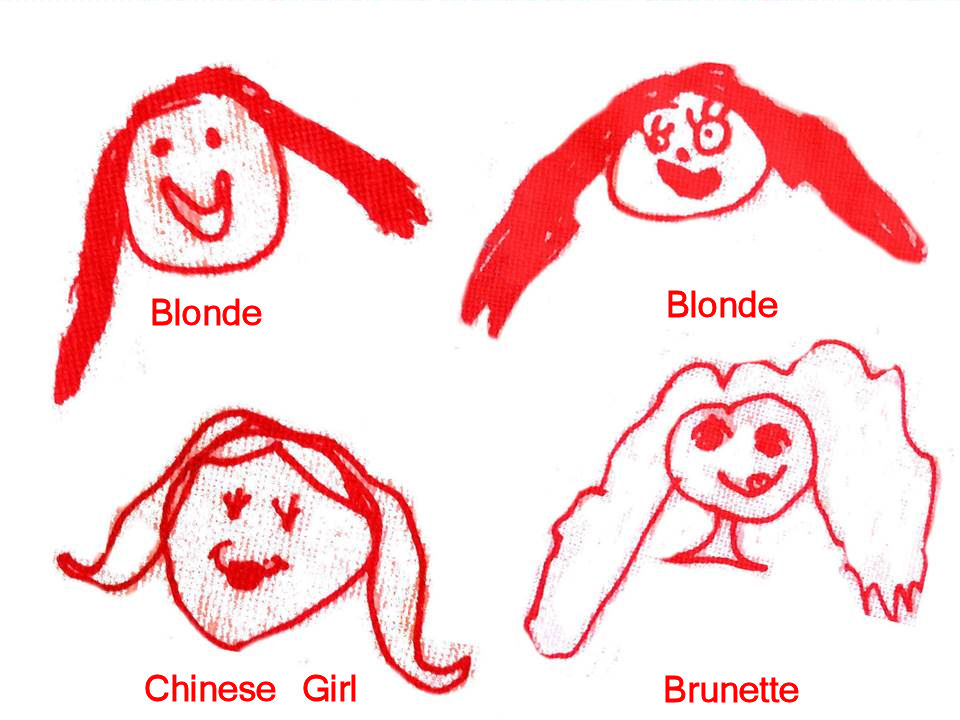
Big Sis: No I don’t, I have yellow hair.

This wasn’t a one off; this sort of thing continued. At the end of Reception, Big Sis’s Year 6 partner gave her a Chinese looking Barbie doll.

Me: That’s nice; she’s given you a Chinese Barbie.

Big Sis: How did she know I was Chinese?

Me: Because you look Chinese.

Big Sis: No I don’t.

Me: You have black hair.

Big Sis: No I don’t.

Me: You have yellowish, brownish skin.

Big Sis: No I don’t, I have light skin.

Me [What the hell?]: silence.

It was not a surprise then that when I bought Big Sis’s Year 1 tea towel with each child in her class’s self-portraits printed on it that I saw that she had depicted herself with “yellow” hair. What I didn’t expect and was relieved to see was that her blonde best friends, drew themselves with black hair, and another European child with dark brown hair also drew herself with “yellow” hair.

Maybe this is not about race then, but something deeper about identity and about wanting to belong. Wanting to be the same as your friends. It struck me that I could learn from this, that difference is in the eye of the beholder and where we seek to find similarity not difference, we can find it – however improbable.

T towel 4

How fast is your child’s thinking?

Core Abilities

I am posting again on my infant 360 degree appraisal series. Core abilities include ‎memory, ‎attention span, processing speed and impulse control. These are factors that affect ability in all other areas. Deficits in core ability will detrimentally affect ability on the other aspects of function. In this post I will cover processing speed and impulsivity.

Processing speed

Processing speed in the brain is exactly the same as the processing speed of your computer. Some computers are just faster than others. If your computer downloads a movie instantly, while others are still buffering, you can imagine who has the advantage. I remember as a child marveling at my older sister’s ability to do sums in her head while I was still scrambling around for fingers and toes to count.  That’s the advantage of processing speed; she was doing the same thing that I was, but just faster and more efficiently and keeping her socks on. Processing speed improves with age in an individual, but there is clearly variation in processing speed between individuals.

Processing speed is all about “how fast” someone can do things. Therefore, in order to test it, you need to know that the child is able to do what you are asking them to do. Tasks chosen should therefore generally be easy. Clinically one measure of processing speed used is a sheet of paper with different symbols on. The child is timed to cross out all the symbols of a particular shape. The score is then based on time taken with a penalty for any false positives (crossed out shapes that were not the specified shape) and false negatives (the correct shape was not crossed out). The task can be varied in difficulty by having all the symbols look very different or very similar. If you are experimentally minded and have an older infant (3 years upwards), you can easily replicate that test at home to gain an idea of processing speed. Here are handy sheets that you can print and use if you are so inclined: Processing Speed Test. Go on, you know you want to, and share with your friends (to find out what their kids score – whilst feigning disinterest of course).

Other simple ways to test processing speed, particularly of younger children include sorting. Sorting items by colour can be mastered easily by an infant and if you time this you can get an idea of the processing speed (again factoring in accuracy). Equally, the time it takes to push shapes through a shape sorter can be used, although this is more of a test for visio-spatial skills, motor skills and processing speed; rather than processing speed alone. Children with good visio-spatial skills and processing speed will be able to do this task quicker. Children that adopt a trial and error approach to the shape-sorter, will get there eventually, but they will be outclassed time wise by someone who is able to process in their head which shape is likely to fit through which hole. Spatial ability is known to predict performance in mathematics and eventual expertise in science, technology and engineering (Tosto, 2014). By the time Lil Bro was one year old, we had acquired so many hand me down toys that we had several shape sorters. The first had only 3 shapes (square, circle and triangle), the second had 10 shapes and the third had about 24 shapes including complex trapeziums and parallelograms. If you are sad like me, you can monitor development through progression of progressively harder shape sorters.

Impulse control/ response inhibition

IMG_3204

It is very easy to observe a child’s impulse control, or largely, lack of it! Most adults are able to control their immediate urge to do something to hold out for a greater reward or avoid punishment. For instance, most of us are able to save money in order to buy something big and we are able to wait our turn rather than push into a queue to avoid being told off. Most toddlers are not able to do this, so if you put a new “toy” in front of them, they will try and grab it even if you tell them not to. Try drinking a glass of wine while holding an alert one to two year old in your lap. Good luck.

Sometime between toddler-dom and adulthood, the ability to control impulses develops and strengthens. The earlier that a child develops impulse control, the better they will be perceived, as this will mean that they will be less likely to do things like touch things that they shouldn’t, shout out in class, push in to queues, interrupt other people talking and running across the road without looking. People tend to like children better if they don’t do these things.

You can easily observe your child’s ability to control impulses by taking them into a fancy department store or if you are more daring a china shop. Immediately, you will be telling your child not to touch anything then you can see how long they last. If you really want to test them, you can mix it up a bit. Say “If you don’t touch anything, I’ll buy you some chocolate on the way out” and see if they fare better, or you can up the ante on the temptation and take them to a sweet shop and expect them not to touch! That would be very cruel indeed.

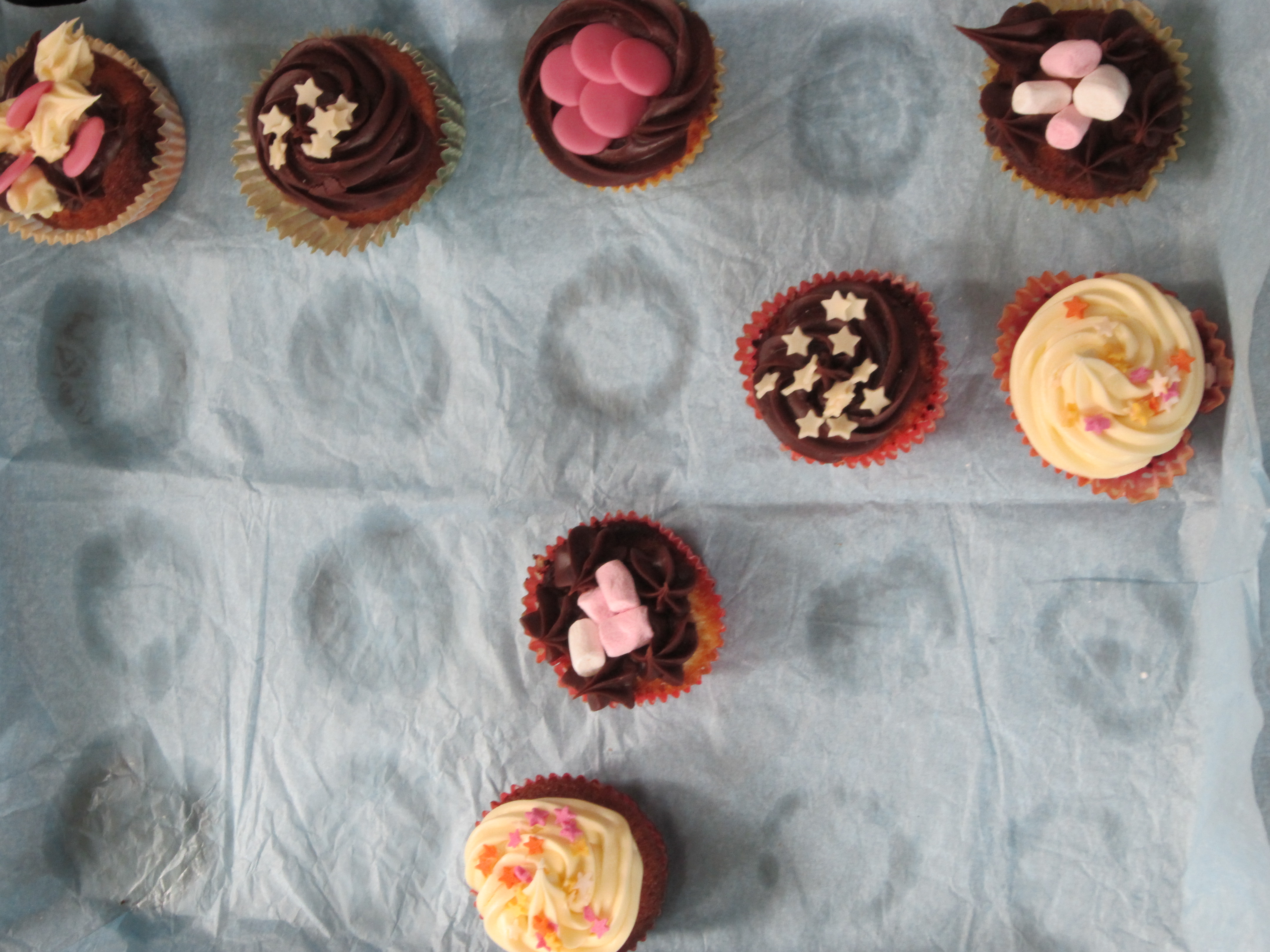
Cruel though is what child psychologists and psychiatrists are in the pursuit of answers, and they actually do this test in the research labs with a cupcake which cannot be eaten despite being left directly in front of the child, on the promise that they will get two cupcakes for leaving it alone. As expected, older children find this easier. This test is very easily replicable at home for anyone who wishes to be so mean (or who has plenty of cupcakes to be eaten)!

IMG_0576

Core-ability training

Like for attention, where repeated episodes of bringing back to task and encouraging goal-oriented attention can increase ‎attention span, so too can processing speed, memory and impulse control be improved. The suggested activities for assessing processing speed, memory, impulse control and attention can also be played in order to train infants on these core abilities.

brain growth

This back of an envelope sketch shows a graph of human brain growth and decline. During infancy the brain is going through massive growth with the child building circuits and connections in the brain in response to its environment at a rapid rate. It is thought that training at this stage in development is likely to physically affect brain development (the interconnections between different parts of the brain) and have larger impact than training at any other time in life. Similarly, continued mental activity (such as playing chess) at the other end of the lifespan can slow the inevitable brain decline in old age by strengthening connections so they are not lost.

There is growing scientific interest in obtaining evidence that attention span and impulse control can be trained. Research into ADHD treatment and prevention are moving towards computer games, aimed at toddlers that will train attention to goal oriented activity (Wass, 2011). Potentially, future ADHD prevention will involve computer-based intervention at infancy rather than medication in childhood. Why wait for a computer game to be developed to do this when parental interaction is much more fun and rewarding. In actuality, many parents are doing this already, only they are doing it instinctively when trying to interact with their child on an activity – encouraging, supporting and helping a child stay focused to complete something fun. Now you can carry on doing these things with the smug knowledge that you are not just passing the time, or playing a game, but also potentially physically improving your child’s brain.

References:
Tosto et al.(2014) Why do spatial abilities predict mathematical performance? Developmental Science (Dev Sci), On-line ahead of print.

Wass et al., Training Attentional Control in Infancy, Current Biology (2011), 21, 1-5.